


Why We Overthink and How to Break the Cycle?
Have you ever replayed a conversation in your head and wondered, “Why did I say that?” Or found yourself imagining everything that could go wrong tomorrow, even though nothing has happened yet?
You may tell yourself to stop thinking about it, but the more you try, the louder the thoughts seem to become.
Overthinking is not simply “thinking too much.” It often becomes a repetitive mental loop—replaying the past, predicting problems, questioning decisions, or searching for certainty that may not be possible to find.
The good news is that you do not have to solve every thought. Learning to recognize the loop and respond differently can help you regain a sense of control.
Why do we overthink?
We often overthink when the mind is trying to solve a problem, prevent a mistake, reduce uncertainty, or make sense of something upsetting. But repeated thinking does not always lead to a solution. When thoughts become repetitive without producing useful action, they can turn into a cycle of worry or rumination that keeps distress going. Research links repetitive negative thinking with symptoms of anxiety and depression, although overthinking itself does not mean that someone has a mental health disorder.
The goal is not to stop thinking altogether. It is to learn when thinking is helping you—and when it is simply keeping you stuck.
What is overthinking?
“Overthinking” is a common everyday term rather than a formal mental health diagnosis.

It can involve repeatedly analyzing a situation, imagining negative outcomes, second-guessing yourself, or revisiting something that has already happened.
Two common patterns are:
- Rumination: repeatedly going over past events, mistakes, feelings, or problems.
- Worry: repeatedly thinking about possible future problems or things that might go wrong.
Both can fall under the broader idea of repetitive negative thinking. Researchers have found that repetitive negative thinking can overlap with worry and rumination and is associated with anxiety and depression symptoms.
Also read : 9 Warning Signs: Your Mind Needs a Break
Thinking versus overthinking
Healthy reflection usually moves somewhere.
For example:
“I made a mistake during the meeting. What can I do differently next time?”
Overthinking may sound more like:
“Why did I say that? What did everyone think? Did I look foolish? Maybe they don’t respect me. What if I ruined everything?”
The first thought can lead to action.
The second can keep generating more questions without giving you a useful next step.
Why does the mind get stuck in an overthinking cycle?
Overthinking can feel strangely productive because your brain is doing something. You are analyzing, remembering, predicting and comparing.
But mental activity is not always problem-solving.
Sometimes the mind is trying to achieve something that is difficult or impossible—such as complete certainty about the future or certainty about what another person thinks.
A typical cycle can look like this:
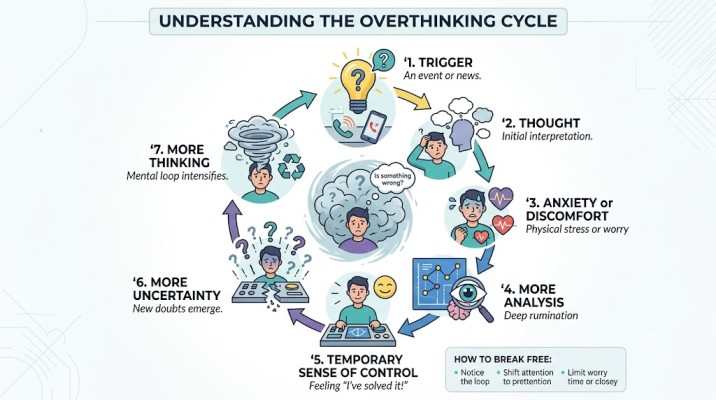
For example, you send an important message and don’t receive a reply.
You might initially think:
“Maybe they’re busy.”
But then uncertainty appears:
“Did I say something wrong?”
You check your phone.
No reply.
Then:
“Maybe they’re upset with me.”
You reread the conversation.
The more you search for certainty, the more possibilities you notice.
That can keep the cycle going.
The relationship between thoughts, feelings and behaviour is also an important part of cognitive behavioural approaches to mental wellbeing.
Why overthinking can make you feel worse
Repeated negative thinking can affect more than your mood.
Research has associated rumination and repetitive negative thinking with difficulties such as prolonged negative mood and reduced problem-solving. It has also been studied in relation to anxiety, depression and other forms of psychological distress.
This does not mean that every person who overthinks has anxiety or depression.
Everyone worries and gets stuck in thoughts sometimes.
The concern is when the pattern becomes frequent, difficult to control, interferes with everyday life, or leaves you feeling increasingly distressed.
How to tell whether your thinking is helping you
When you notice yourself going over the same thought again and again, ask:
“Am I solving something right now, or am I trying to get certainty that I cannot get?”
Then ask:
- Is there a problem I can actually act on?
- What information do I genuinely need?
- What is within my control?
- What is outside my control?
- Is another round of thinking likely to change anything?
If there is a practical action available, take it.
If there isn’t, continuing to analyze the situation may simply keep the mental loop alive.
7 practical ways to break the overthinking cycle
1. Name the loop
The first step is noticing what is happening.
Instead of saying:
“Something is wrong with me. I can’t stop thinking.”
Try:
“I’m caught in an overthinking loop.”
That small change creates some distance between you and the thought.
You are noticing the process rather than automatically following it.
2. Separate the problem from the thought
Write down exactly what is bothering you.
Then divide the page into two parts:
What I can control
- What I say
- What I do next
- Whether I apologize
- Whether I prepare
- Whether I ask for clarification
What I cannot control
- What someone thinks
- What already happened
- The exact future outcome
- Whether another person responds immediately
Focus your energy on the first list.
Problem-solving techniques can make overwhelming problems feel more manageable by helping you identify priorities, possible solutions and specific next actions.
3. Challenge the thought instead of automatically believing it
A thought can feel convincing without being a fact.
Try asking:
- What evidence supports this thought?
- What evidence does not support it?
- Am I assuming the worst?
- Are there other possible explanations?
- What would I say to a friend in the same situation?
This approach is similar to the NHS’s “catch it, check it, change it” technique for examining unhelpful thoughts.
You don’t need to replace a negative thought with an unrealistically positive one.
A balanced thought is often more useful.
Instead of:
“Everyone thinks I failed.”
Try:
“I don’t actually know what everyone thinks. I made one mistake, and I can learn from it.”
4. Give your worry a limited time
Sometimes telling yourself “Don’t think about it” makes the thought even harder to ignore.
Instead, try setting aside a short worry period.
For example:
7:00–7:15 PM — worry and problem-solving time
When a thought appears earlier in the day, write it down and tell yourself:
“I’ll come back to this during my worry time.”
The NHS recommends a short, planned period for worrying as one technique that may help people manage thoughts that are difficult to switch off.
You may find that some concerns feel much less urgent when you revisit them later.
5. Stop asking “What if?” and ask “What now?”
“What if?” can generate endless possibilities.
Try replacing it with:
“What can I do now?”
For example:
What if I fail?
→ What can I prepare today?
What if they are angry with me?
→ Can I communicate clearly?
What if something goes wrong?
→ What is one sensible backup plan?
This moves your mind from prediction to action.
6. Use a thought record
When one thought keeps returning, write it down instead of carrying it around mentally.
A simple version is:
Situation: What happened?
Automatic thought: What did I immediately tell myself?
Feeling: What emotion did I notice?
Evidence for the thought: What supports it?
Evidence against it: What doesn’t support it?
Balanced thought: What is a more realistic way to see this?
This kind of structured thought record is used in CBT-based self-help approaches.
The goal isn’t to force yourself to think positively.
It is to think more flexibly.
7. Do something that brings you back into the present
Overthinking often pulls your attention into the past or future.
A simple physical activity can help interrupt that mental momentum.
Try:
- Taking a short walk
- Stretching
- Making a cup of tea
- Tidying one small area
- Talking to someone you trust
- Taking several slow breaths
- Putting your phone away for a while
- Doing one small task that requires your attention
The aim isn’t to run away from your thoughts.
It is to stop giving every thought unlimited attention.
Try this 5-minute overthinking reset
The next time your mind starts racing, try this:
Minute 1 — Notice
Say:
“My mind is looping.”
Minute 2 — Write
Write down the thought that keeps returning.
Minute 3 — Separate
Ask:
“Is this a problem I can act on, or uncertainty I am trying to eliminate?”
Minute 4 — Choose
If you can act, choose one small action.
If you cannot act, remind yourself:
“I don’t need to solve this right now.”
Minute 5 — Shift
Stand up and do something physical for a few minutes.
You may not feel completely calm immediately—and that is okay.
The goal is to practice responding differently to the thought.
What not to do when you are overthinking
Some habits can unintentionally keep the cycle going.
Try not to:
- repeatedly check your phone for reassurance
- replay the same conversation dozens of times
- search endlessly for certainty online
- ask several people the same question just to feel reassured
- treat every negative possibility as a prediction
- criticize yourself for having thoughts
Most importantly, don’t turn “I need to stop overthinking” into another thought you obsess over.
You don’t need to control every thought.
You need to change how you respond to it.
When should you seek professional help?
Occasional overthinking is part of normal life.
However, consider talking with a qualified mental health professional if persistent worrying or repetitive thoughts are causing significant distress or interfering with sleep, relationships, work, studies, or everyday activities.
Overthinking can occur alongside anxiety, depression and other mental health difficulties, but only a qualified professional can assess what may be happening in an individual situation. Research also supports psychological approaches for reducing repetitive negative thinking and related symptoms.
Seeking help does not mean you are weak or that you have failed to manage your mind.
Sometimes you simply need better tools and support.
The bottom line: You don’t have to solve every thought
Overthinking often begins with a reasonable goal: understand what happened, prevent a mistake, or prepare for what might happen next.
The problem begins when thinking stops producing useful action and becomes a repetitive loop.
So the next time you notice your mind going over the same situation again, pause and ask:
“Is this thought helping me solve something—or is it keeping me stuck?”
If there is something you can do, choose one small action.
If there isn’t, practice letting the uncertainty exist without continuing to analyze it.
You don’t need a completely quiet mind to feel better.
You can learn to stop following every thought.
Frequently Asked Questions
Is overthinking a mental illness?
No. Overthinking is not, by itself, a mental illness or formal diagnosis. Repetitive worrying or rumination can occur as part of normal life, but persistent patterns may also occur alongside conditions such as anxiety or depression.
Why can’t I stop overthinking?
Overthinking can continue because your mind is trying to solve a problem, prevent a mistake, or gain certainty. Unfortunately, repeatedly analyzing the same situation does not always provide certainty and can keep the cycle going.
How do I stop overthinking at night?
Write down the concern and decide whether there is a practical action you can take tomorrow. If there is, note the action. If there isn’t, remind yourself that you don’t need to solve it tonight. A short, planned “worry time” earlier in the day may also help some people manage recurring worries.
How do I stop replaying conversations in my head?
First, identify whether there is anything useful you can learn or do. If there is, write down the lesson or next action. If there isn’t, remind yourself that replaying the conversation cannot change what already happened. Try shifting your attention to a present activity.
What is the difference between thinking and overthinking?
Useful thinking generally helps you understand a situation, make a decision or take action. Overthinking tends to repeat the same questions, possibilities or memories without moving toward a useful resolution.
Can overthinking affect your mental health?
Persistent repetitive negative thinking is associated with psychological distress and has been studied in relation to anxiety and depression. However, occasional overthinking is common and does not automatically indicate a mental health condition.