

9 Warning Signs: Your Mind Needs a Break
You can be physically tired and still keep going. But sometimes, your body is resting while your mind is still running.
You may sit down after a busy day, yet your thoughts continue jumping from one task to another. You forget small things, feel irritated over little problems, or stare at your to-do list without knowing where to begin.These can be signs your mind needs a break.
Many of us notice physical tiredness quickly. Mental tiredness is easier to overlook because we can continue working even when our attention, patience, and emotional energy are running low.
A busy mind does not always need more motivation. Sometimes, it needs space to pause, breathe, and recover.
What Does It Mean When Your Mind Needs a Break?
Mental fatigue can happen when your brain has been dealing with prolonged concentration, stress, emotional demands, constant decisions, or too much stimulation without enough recovery time.
Research and health guidance describe mental exhaustion in terms such as difficulty concentrating, irritability, low motivation, feeling overwhelmed, and emotional depletion.
This does not mean that every difficult day is a sign of a serious problem. Everyone becomes mentally tired sometimes.
The important thing is to notice patterns.
If you regularly feel like your mind is overloaded, stepping back for some mental rest may be more helpful than simply pushing yourself harder.
These signs your mind needs a break can be subtle at first.
9 Signs Your Mind Needs a Break
1. Simple Tasks Suddenly Feel Difficult
You normally know what needs to be done, but today even small tasks feel strangely complicated.
Replying to an email, preparing dinner, organising your desk, or deciding what to do first may require much more effort than usual.
You may keep looking at a task without actually starting it.
This can happen when your attention is already overloaded. Mental fatigue can make routine tasks feel more challenging.
Instead of immediately calling yourself lazy, pause and ask:
“Have I been mentally switched on for too long?”
2. You Can’t Concentrate Like You Usually Do
You read the same paragraph several times but cannot remember what it said.
You open your phone to check one thing and suddenly find yourself scrolling through something completely unrelated.
Difficulty concentrating is one of the common signs your mind needs a break.
A short pause from demanding mental work can sometimes give your attention a chance to recover. The American Psychological Association also recommends mental rest, including breaks from mentally demanding activities.
3. You Become Irritated Over Small Things
A small mistake suddenly feels extremely annoying.
Someone asks you a simple question, and you respond more sharply than you intended.
You may later wonder, “Why did that bother me so much?”
It does not necessarily mean that something is wrong with you.
Sometimes, you simply have very little mental energy left.
4. Your Thoughts Won’t Slow Down
Your body is sitting quietly, but your mind is still working.
You think about tomorrow’s responsibilities.
Then you remember something you forgot today.
Then another worry appears.
Then you start planning what might happen next week.
This constant mental activity can leave you feeling exhausted even when you have not been physically active.
Mental rest can involve deliberately creating periods when you are not solving problems, planning, checking notifications, or consuming information.
5. You Keep Forgetting Small Things
You walk into a room and forget why you went there.
You misplace your keys.
You forget a message you intended to answer.
You know you have something to do, but you cannot remember what it was.
Occasional forgetfulness is normal. But when it appears alongside stress, poor concentration, and mental exhaustion, it may be a sign that your attention is overloaded.
These are signs your mind needs a break, not necessarily signs that you need to work harder.
6. You Feel Overwhelmed by Your To-Do List
Sometimes the problem isn’t the number of tasks.
It is that your brain no longer knows where to begin.
You look at ten things that need attention and feel unable to start even one.
When your mental energy is low, reducing stimulation and choosing one small task can feel more manageable than trying to solve everything at once.
Try asking:
“What is the one thing that actually needs my attention right now?”
You don’t have to finish your entire life in one afternoon.
7. Things You Normally Enjoy Don’t Feel Enjoyable
Maybe you usually enjoy talking with friends, watching a favourite programme, reading, cooking, or going for a walk.
But lately, you feel disconnected from those activities.
You simply want to be left alone.
Temporary loss of enthusiasm can happen when you are mentally drained. Mental exhaustion can include reduced motivation and less interest in activities that normally feel rewarding.
This is one reason rest should not be treated as laziness.
Sometimes your mind needs recovery before it can fully enjoy things again.
8. You Keep Making Small Mistakes
You type the wrong word.
Forget an appointment.
Miss a small detail.
Make a simple mistake in something you normally handle easily.
Mental fatigue can affect attention and efficiency, especially during prolonged periods of demanding activity.
Rather than immediately pushing yourself harder, consider taking a short break.
A few quiet minutes away from the task may be more useful than staring at the same screen for another hour.
9. You Feel Tired Even After Resting
You slept, but your mind still feels heavy.
You took some time off, but you return to your responsibilities already feeling overwhelmed.
Sometimes physical rest and mental rest are not exactly the same thing.
Mental rest means giving your brain a chance to step away from constant thinking, decision-making, emotional processing, and information.
The American Psychological Association describes mental rest as giving the brain opportunities to quiet down and recover from prolonged mental activity. (American Psychological Association)
If several of these signs your mind needs a break are happening together, it may be time to slow down rather than keep adding more pressure.
How to Give Your Mind a Real Break
A mental break does not have to mean taking an expensive holiday or spending an entire day doing nothing.
Start small.
Put your phone away for a while.
Step outside and take a slow walk.
Sit somewhere quiet without consuming more information.
Do a simple activity that does not require intense concentration.
Write down the thoughts that keep circling in your head.
Take a few slow breaths and pay attention to what you can see and hear around you.
You can also divide demanding work into smaller periods with short breaks between them. Short breaks during prolonged mental work may help reduce feelings of mental exhaustion. (WebMD)
Most importantly, do not turn your break into another task you have to perform perfectly.
The purpose is to give your mind less to process.
Common Mistakes to Avoid
Mistake 1: Waiting Until You Completely Burn Out
You don’t have to reach complete exhaustion before taking a break.
Small pauses throughout the day can be easier than trying to recover after months of constant pressure.
Mistake 2: Treating Rest as Laziness
Rest is not the opposite of productivity.
Your mind needs recovery just as your body does.
Taking a break can help you return to a task with greater clarity instead of forcing yourself through mental fog.
Mistake 3: Filling Every Break With Your Phone
Scrolling may feel relaxing, but it can also keep your brain processing more information.
Try having some breaks without notifications, social media, news, or constant entertainment.
Mistake 4: Trying to Fix Everything at Once
You don’t need ten new habits tomorrow morning.
Choose one small change.
Maybe it is a ten-minute walk. Maybe it is putting your phone away during meals. Maybe it is giving yourself a quiet period before bed.
Small, realistic changes are easier to maintain.
When Should You Seek Extra Support?
Mental tiredness can happen for many everyday reasons, including stress and prolonged mental demands. But persistent or worsening changes deserve attention.
If tiredness, low mood, anxiety, concentration problems, sleep difficulties, or loss of interest continue for a significant period or interfere with daily life, consider speaking with a qualified healthcare professional.
A mental break can be helpful, but it should not replace professional support when you need it.
If you ever feel unable to cope or unsafe, seek immediate help from an appropriate local emergency or mental-health service.
A Simple Mind-Reset Routine
You can try this whenever you notice several signs your mind needs a break:
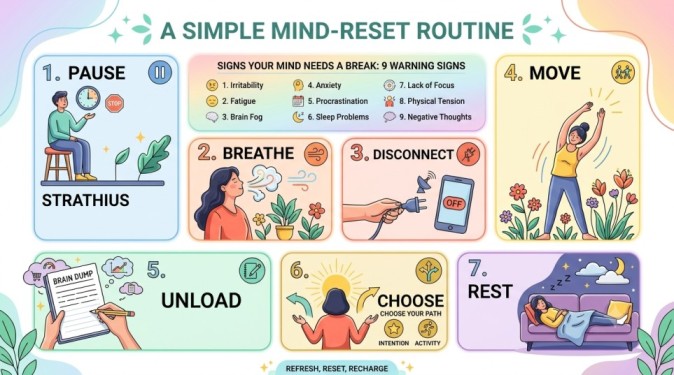
Pause: Stop what you are doing for a few minutes.
Breathe: Take slow, comfortable breaths without forcing them.
Disconnect: Put unnecessary notifications and screens aside.
Move: Stretch or take a gentle walk.
Unload: Write down the thoughts competing for your attention.
Choose: Decide what genuinely needs to happen next.
Rest: Give yourself permission to stop when the important work is done.
You don’t have to earn rest by reaching exhaustion.
Final Thoughts
Your mind may not always tell you directly that it needs rest.
Sometimes it shows you through forgetfulness, irritation, racing thoughts, poor concentration, low motivation, or the feeling that even simple things are too much.
Learning to notice these signs your mind needs a break can help you respond earlier.
You don’t have to abandon your responsibilities. You simply need to remember that you are a person, not a machine.
Sometimes the most productive thing you can do is pause.
Give yourself a little quiet.
Take a breath.
Step away.
And come back when your mind has a little more room.
For more practical ideas around mental well-being, mindfulness, emotional balance, and healthier daily habits, Awellora’s Mind section brings these topics together in one place.
Health Note
This article is for general education and well-being information. It is not a diagnosis or a substitute for professional medical or mental-health advice.
FAQs
1. What are the signs your mind needs a break?
Common signs include difficulty concentrating, forgetfulness, irritability, racing thoughts, low motivation, feeling overwhelmed, and losing interest in normal activities.
2. How do I know if I am mentally tired?
You may notice that everyday tasks require more effort, your attention is weaker, you become easily irritated, or your thoughts continue running even when you are physically resting.
3. How can I give my mind a break?
Try stepping away from demanding tasks, reducing screen stimulation, taking a walk, sitting somewhere quiet, writing down racing thoughts, or spending a few minutes without notifications.
4. Can stress make you mentally tired?
Yes. Prolonged stress can contribute to mental fatigue and may affect concentration, mood, motivation, sleep, and daily functioning.
5. Is taking a mental break being lazy?
No. Mental rest is a normal part of recovery. Taking breaks from demanding mental activities can give your brain time to recover.
6. How often should I take a mental break?
There is no single schedule that works for everyone. Consider taking short breaks during long periods of concentrated work and paying attention to your own signs of mental fatigue.
7. When should I talk to a professional?
If mental tiredness, low mood, anxiety, sleep problems, concentration difficulties, or loss of interest persist, worsen, or interfere with everyday life, professional support can be appropriate.