

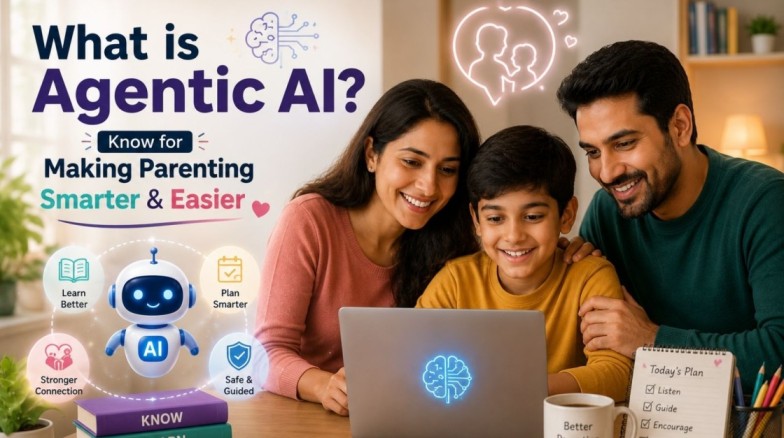
What Is Agentic AI? A Parent’s Simple Guide
A few years ago, most parents were worried about too much screen time.
Now, many families are asking a new question:
“Can AI actually think and act on its own?”
From homework helpers to AI chatbots and smart learning apps, technology is changing faster than many parents expected. Children are growing up in a world where AI can answer questions, create stories, make study plans, and even behave like a digital assistant.
This new wave of technology is called Agentic AI.
For many parents, it sounds exciting… but also overwhelming.
Many families go through this, and you’re not alone.
The good news is that you do not need to be a tech expert to understand what Agentic AI means for your child. With the right guidance, parents can help children use AI in a healthy, balanced, and responsible way.
What Is Agentic AI?
Agentic AI is a type of artificial intelligence designed to do more than simply respond to commands.
Instead of only answering questions, it can:
- plan tasks,
- make decisions,
- take actions,
- and work toward a goal step by step.
Think of it like the difference between a calculator and a personal assistant.
A calculator waits for instructions.
An AI agent can organize information, suggest next steps, and complete tasks with less human guidance.
For example, if a student says:
“Help me prepare for my science exam.”
A traditional AI tool may only explain a chapter.
But Agentic AI may:
- create a study schedule,
- identify weak topics,
- generate quiz questions,
- remind the student to revise,
- and track learning progress.
That is why many experts believe Agentic AI may shape the future of education and family life.
Why Parents Are Hearing About Agentic AI More Often
AI tools are becoming part of everyday life very quickly.
Children already interact with AI through:
- homework apps,
- search engines,
- voice assistants,
- educational platforms,
- and content recommendations.
Now, newer AI systems are becoming more independent and interactive.
Companies like OpenAI and Google DeepMind are developing AI systems that can perform more complex tasks instead of only giving short answers.
This shift is why the term “Agentic AI” is becoming more common in parenting and education discussions.
How Agentic AI May Help Students
Many parents worry that AI will make children lazy.
But when used thoughtfully, AI can also support learning in meaningful ways.
Personalized Learning Support
Every child learns differently.
Some children need repetition. Others learn better visually. Some lose confidence quickly when they struggle in school.
Agentic AI can adapt lessons and explanations according to the child’s pace and learning style.
This can help reduce frustration and build confidence over time.
Better Study Organization
One of the biggest challenges for students is not intelligence — it is consistency.
Children often feel overwhelmed by:
- unfinished homework,
- multiple subjects,
- exams stress
- and distractions.
AI tools can help students break large tasks into smaller, manageable steps.
For busy families, this extra structure can sometimes reduce stress at home.
Encouraging Curiosity
Children are naturally curious.
When a child suddenly asks:
“How do airplanes fly?”
“Why does the moon change shape?”
“Can robots think like humans?”
AI tools can help answer questions instantly and keep curiosity alive.
That curiosity matters because learning becomes stronger when children genuinely enjoy exploring ideas.
How Agentic AI May Help Parents
Parents today are carrying emotional and mental pressure from many directions.
School expectations, digital safety, work responsibilities, and family routines can feel exhausting.
Used carefully, Agentic AI may become a practical support tool for families.
Helping Parents Save Time
AI can help parents:
- create study routines,
- organize schedules,
- prepare educational activities,
- and simplify planning.
This does not replace parenting.
It simply reduces some daily pressure.
Supporting Conversations With Children
Sometimes children open up more comfortably through activities, creativity, or shared learning experiences.
AI-generated stories, quizzes, or discussion prompts can create opportunities for meaningful conversations between parents and children.
That emotional connection still matters more than technology itself.
The Emotional Side of AI That Many Families Feel
Many parents quietly fear something deeper than technology.
They fear losing connection with their children.
A mother may notice her child asking AI more questions than asking family members.
A father may wonder:
“Will my child stop thinking independently?”
These concerns are understandable.
Technology changes quickly, but children still need the same things they always needed:
- attention,
- emotional safety,
- guidance,
- conversation,
- and human connection.
AI should support family life — not replace relationships.
Common Mistakes to Avoid
As AI becomes more common, many families unintentionally fall into unhealthy habits.
Using AI as a Complete Replacement for Learning
If children copy answers without understanding concepts, learning becomes weaker over time.
Parents should encourage children to ask:
- “Why is this correct?”
- “Can I explain this myself?”
- “Do I truly understand it?”
Too Much Screen Dependence
Educational AI can still increase screen exposure.
Children need balance through:
- outdoor play,
- hobbies,
- physical activity,
- reading,
- and real conversations.
Trusting Every AI Answer
AI tools can sometimes provide inaccurate or misleading information.
Teaching children critical thinking is more important than ever.
According to UNICEF, digital literacy and online safety are becoming essential life skills for modern children and families.
Practical Tips for Parents Using AI at Home
You do not need to fear AI.
But children do need guidance.
Here are a few healthy ways families can approach Agentic AI:
Stay Curious Together
Instead of rejecting technology completely, explore it together.
Ask your child:
“What did the AI teach you today?”
This builds trust and communication.
Set Healthy Boundaries
Create simple family rules around:
- screen time,
- homework use,
- and responsible AI usage.
Children feel safer when boundaries are calm and consistent.
Focus on Human Skills
In the future, emotional intelligence may become even more valuable.
Encourage children to develop:
- creativity,
- empathy,
- communication,
- teamwork,
- and problem-solving.
These human skills cannot easily be replaced by machines.
Will Agentic AI Replace Teachers or Parents?
No technology can replace emotional connection.
Teachers inspire confidence.
Parents build emotional security.
Families shape values and character.
AI may become a powerful educational assistant, but children still need human guidance to grow emotionally and socially.
The goal is not to compete with technology.
The goal is to help children use technology wisely.
Final Thoughts
Agentic AI may sound futuristic, but for many families, it is already becoming part of everyday life.
Children are growing up in a world where AI can teach, organize, create, and assist in ways previous generations never experienced.
That change can feel uncomfortable at first.
But parents do not need to have every answer immediately.
What matters most is staying involved, asking questions, setting healthy boundaries, and keeping human connection stronger than screens.
Because even in an AI-powered world, children still learn best through trust, love, guidance, and meaningful relationships.
FAQ
1: What is Agentic AI in simple words?
Agentic AI is a type of AI that can plan, make decisions, and complete tasks step by step instead of only answering questions.
2: Is Agentic AI safe for children?
Agentic AI can be helpful when used with parental guidance, healthy boundaries, and balanced screen time habits.
3: How can students use Agentic AI for learning?
Students can use Agentic AI for study planning, homework help, revision practice, and understanding difficult topics more easily.
F4: Will AI replace teachers in schools?
AI may support education, but teachers remain important for emotional guidance, motivation, discipline, and human connection.
5: What are the risks of Agentic AI for families?
Possible risks include screen dependence, misinformation, privacy concerns, and overreliance on technology without critical thinking.
6: How should parents introduce AI to children?
Parents should explore AI together with children, encourage questions, teach digital safety, and set healthy limits for usage.
7: Why is Agentic AI becoming popular now?
AI technology is becoming more advanced and capable of completing tasks independently, which is why Agentic AI is gaining attention in education and daily life.