


9 Practical Parent–Child Bonding Tips to Build a Stronger Relationship
Building a strong parent-child bond doesn’t require expensive outings, perfect parenting, or hours of free time every day. Often, it grows through small moments—listening to your child after school, talking during dinner, reading before bedtime, or simply being present when they need you.
A strong parent-child relationship is built on trust, attention, respect, affection, and open communication. Whether your child is five or fifteen, the way you connect may change, but the need to feel loved and understood remains.
If you’re looking for simple parent-child bonding tips, start with small changes that fit naturally into your daily life. Here are nine practical ways to build a closer and more trusting relationship with your child.
Why Parent–Child Bonding Matters

Children need more than food, education, and physical care. They also need to feel emotionally safe and connected to the people who care for them.
A healthy parent-child bond gives children a place where they can share their happiness, worries, mistakes, and questions without constantly fearing criticism. It can also make everyday communication easier as children grow older.
A strong connection doesn’t mean parents should agree with everything their children do. It means children know that even when they make mistakes or face consequences, they are still loved and respected.
This is where awareness about parent mental health becomes important, because emotionally exhausted parents often struggle to connect deeply. Taking care of your emotional well-being directly impacts your relationship with your child.
Research on parent-child relationships research shows that when parents respond warmly and consistently to a child’s emotions and actions, it strengthens the child’s brain development and builds a lifelong foundation of trust and emotional security
How a Strong Parent–Child Bond Helps Children
A healthy emotional connection can help children:
- Feel secure and valued
- Communicate more openly
- Develop confidence
- Handle difficult emotions
- Build trust with their parents
- Learn how healthy relationships work
Most importantly, bonding is not something you build in one big moment. It grows through many small moments repeated over time.
Reducing screen time for kids by age during these moments can significantly improve connection. Even 15 minutes of distraction-free interaction daily can make a huge difference in long-term bonding.
9 Practical Parent–Child Bonding Tips
1. Create Small Daily Moments of Connection
You don’t need to plan a special activity every day to build a stronger relationship with your child. Ordinary routines can become meaningful bonding opportunities.
Talk while having breakfast. Ask about their school day. Walk together after dinner. Help them prepare something in the kitchen. Sit beside them for a few minutes before bedtime.
The important thing is to be genuinely interested in what is happening in their world.
Even 10–15 minutes of focused attention can become a valuable daily habit.
Instead of asking only, “Did you finish your homework?” sometimes ask:
“What was the best part of your day?”
Small conversations like these help children feel that their experiences matter to you.
2. Listen Without Interrupting or Immediately Giving Advice

One of the simplest parent-child bonding tips is also one of the hardest: listen before you try to fix the problem.
When children tell you about something that upset them, it can be tempting to immediately explain what they should have done.
But sometimes they simply want to feel heard.
Instead of saying:
“Don’t worry. It’s nothing.”
Try:
“I can see that you’re upset. Do you want to tell me what happened?”
Listening doesn’t mean agreeing with everything your child says. It means giving them enough space to express themselves before responding.
When children learn that they can talk without being immediately judged or interrupted, they may become more comfortable sharing important things with you. This understanding supports healthy child psychology and behavior and prevents emotional disconnect.
3. Show Love in Ways Your Child Understands
Every child may respond differently to affection. Some enjoy hugs and physical closeness, while others may feel more connected through conversations, shared activities, encouragement, or practical help.
Show your child that you notice their efforts.
Say:
“I noticed how patiently you worked on that.”
Or simply:
“I’m happy you told me about this.”
Spend time doing something they enjoy, even if it isn’t your favorite activity.
Love is not only expressed through big celebrations and gifts. Often, children remember the everyday moments when a parent stopped, listened, smiled, encouraged them, or made time for them.
4. Handle Conflicts Without Damaging Trust
Arguments are a normal part of family life. Strong parent-child bonding doesn’t mean there will never be disagreements.
What matters is how you handle them.
When you’re angry, try to avoid insults, humiliation, threats, or statements such as “You never do anything right.”
Instead, focus on the behavior and calmly explain the boundary.
Rather than:
“You never listen to me!”
Try:
“I’m upset about what happened. Let’s talk about it and decide what we can do differently next time.”
And if you lose your temper, don’t be afraid to apologize.
A parent saying, “I shouldn’t have spoken to you that way. I’m sorry,” teaches children that taking responsibility is a strength.
This dedicated time helps children open up about thoughts they may not share in front of others. It also helps parents notice emotional changes early, supporting better parent–child communication skills.
5. Make Time for One-on-One Connection
Children can feel connected to the family and still need individual attention from a parent.
You don’t need an expensive outing. One-on-one time could be:
- Taking a short walk
- Cooking together
- Reading a book
- Playing a game
- Going shopping
- Drawing or doing a hobby
- Talking before bedtime
Let your child sometimes choose what you do together.
Put aside your phone and other distractions and give them your full attention.
The goal isn’t to create a perfect activity. The goal is to make your child feel:
“Right now, I have my parent’s attention.”
Saying things like “I understand you’re upset” instead of “It’s nothing” teaches emotional awareness. Parents who educate themselves about child mental health awareness are better prepared to support children during emotional challenges.
6. Validate Your Child’s Feelings
Children don’t always react to situations in ways adults expect. A small problem to you may feel very important to them.
Instead of immediately saying:
“That’s not a big deal.”
Try acknowledging the feeling:
“I understand why you’re disappointed.”
Or:
“It sounds like that really upset you.”
Validating a feeling doesn’t mean approving every behavior. You can accept the emotion while still setting a healthy boundary.
For example:
“It’s okay to feel angry, but it’s not okay to hurt someone.”
This teaches children that emotions are normal and can be handled safely.
Practicing mindful parenting habits helps parents become emotionally present and self-aware, benefiting both parent and child.
7. Be the Example You Want Your Child to Follow
Children learn from what parents do every day.
If you want your child to communicate respectfully, try to communicate respectfully yourself. If you want them to apologize when they make a mistake, show them that you can apologize too.
Let them see you:
- Listen patiently
- Manage frustration
- Keep promises
- Speak respectfully
- Admit mistakes
- Treat others kindly
You don’t have to be a perfect parent. In fact, showing children how you handle mistakes can teach them something valuable.
Children often learn more from what we repeatedly do than from what we repeatedly tell them to do.
8. Adapt Your Connection as Your Child Grows
The way you bond with a young child may not work in exactly the same way when they become a teenager.
As children grow, they need more independence while still needing emotional support.
With Young Children
Try:
- Playing together
- Reading bedtime stories
- Giving appropriate affection
- Talking about their feelings
- Involving them in simple household activities
With School-Age Children
Try:
- Asking about their interests
- Listening to their school experiences
- Playing games together
- Encouraging their hobbies
- Having regular one-on-one time
With Teenagers
Try:
- Respecting reasonable privacy
- Listening without turning every conversation into a lecture
- Showing interest in their world
- Respecting their growing independence
- Staying available when they need you
Sometimes bonding with a teenager means knowing when to talk—and when to simply stay nearby.
9. Put Away Distractions During Important Moments
Being physically present doesn’t always mean being emotionally present.
A parent may be sitting beside a child while checking messages, answering notifications, or scrolling through social media. Over time, these small distractions can take attention away from opportunities for connection.
During meals, conversations, bedtime, or one-on-one time, try putting your phone aside so your child gets your full attention.
You don’t need to eliminate technology from family life. Just create some distraction-free moments where your child knows they have your attention.
Parent–Child Bonding Ideas for Different Ages
There is no single perfect way to build a parent-child relationship. The best activities depend on your child’s age, personality, and interests.
Bonding With Young Children
Play, read, sing, draw, cook simple things together, or let your child help with safe household tasks.
For young children, even ordinary activities can feel special when a parent is fully involved.
Bonding With School-Age Children
Take an interest in their hobbies, ask about their friends and school experiences, play games together, or invite them to help you with something.
Don’t make every conversation about homework, grades, or responsibilities.
Bonding With Teenagers
Teenagers may not always show that they need connection, but that doesn’t mean they don’t.
Give them space while remaining available. Listen without immediately judging or lecturing. Ask about their interests and respect their growing independence.
Sometimes a quiet drive, a short walk, or a casual conversation while having a snack can create more connection than a planned “serious talk.”
What to Say When Your Child Is Struggling
Sometimes the words we choose can either open the door to communication or close it.
When Your Child Is Upset
Instead of:
“Stop crying. It’s not that serious.”
Try:
“I can see you’re having a difficult time. Do you want to talk about it?”
When Your Child Makes a Mistake
Instead of:
“I told you this would happen.”
Try:
“Let’s understand what happened and think about what we can do differently next time.”
When Your Teenager Doesn’t Want to Talk
Instead of forcing them to explain everything, try:
“You don’t have to talk right now. I’m here whenever you’re ready.”
These small changes in communication can make children feel safer about coming to you.
Common Mistakes That Can Weaken Parent–Child Bonding
Even caring parents can sometimes develop habits that unintentionally create distance.
Constant Criticism
Correcting everything a child does can make them afraid of making mistakes or sharing problems.
Trying to Fix Every Problem
Children sometimes need a listening ear before they need a solution.
Comparing Children With Others
Statements such as “Why can’t you be like…” can hurt confidence and create resentment.
Being Physically Present but Emotionally Distracted
If your phone gets more attention than your child during important moments, connection can suffer.
Refusing to Apologize
Parents make mistakes too. A sincere apology can strengthen trust and teach children accountability.
How to Strengthen Your Parent–Child Bond Every Day
You don’t have to change your entire routine. Start with one small habit.
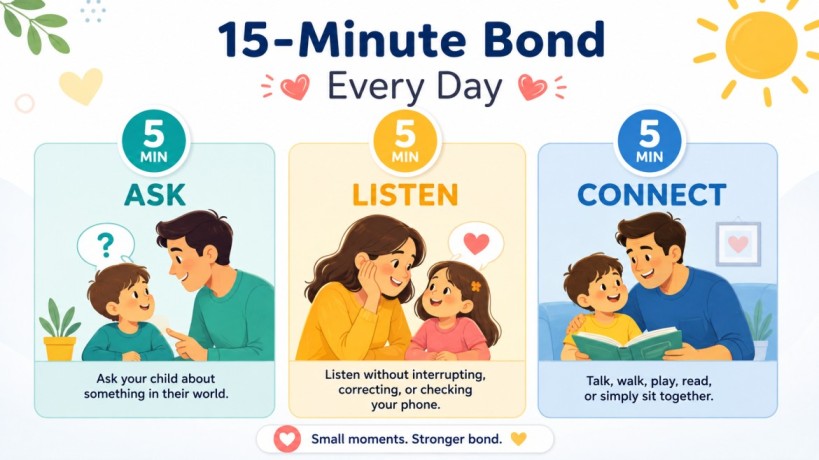
A Simple 15-Minute Connection Routine
5 minutes — Ask:
Ask your child about something happening in their world.
5 minutes — Listen:
Listen without interrupting, correcting, or checking your phone.
5 minutes — Connect:
Talk, walk, play, read, or simply sit together.
Do this regularly rather than expecting one big family activity to solve everything.
Consistency matters more than perfection.
Final Thoughts: Small Moments Build Strong Bonds
You don’t need to become a perfect parent to build a strong relationship with your child.
Start small. Listen a little longer. Put your phone away during one conversation. Ask about something your child genuinely cares about. Share a meal, take a walk, or spend a few quiet minutes together.
These moments may seem ordinary, but repeated over time, they can build something important: trust, emotional safety, and a lasting parent-child connection.
Today, try giving your child just 15 minutes of your complete attention—with no phone, no lecture, and no distractions.
Sometimes, being fully present is one of the most meaningful ways to say, “You matter to me.”
FAQs
How can I build a stronger bond with my child?
Give your child regular attention, listen without immediately judging or correcting, show affection, respect their feelings, and create small moments of connection every day.
What are some simple parent-child bonding activities?
Walking, cooking, reading, playing games, drawing, shopping, doing household tasks, or simply talking together can all become meaningful bonding activities.
How can I bond with my teenager?
Listen without turning every conversation into a lecture. Show interest in their world, respect their growing independence, and remain emotionally available when they need you.
What if my child does not want to talk to me?
Avoid forcing the conversation. Let your child know that you’re available and create relaxed opportunities to talk later. Consistent patience can help rebuild openness.
Can 15 minutes a day improve parent-child bonding?
Fifteen minutes is a practical starting point for focused, distraction-free connection. The exact amount of time matters less than being present and consistent.